India Retail Real Estate Q3 2026: Leasing at 2.22 MSF, Mall Vacancy Below 5%, and What It Means for Bengaluru
Retailers kept signing leases between July and September 2026, but they increasingly had to do it on the high street — because India's quality malls are running out of space. Here's a breakdown of Cushman & Wakefield's Q3 2026 Retail MarketBeat, with a closer look at Bengaluru.
The Quarter in Brief
According to Cushman & Wakefield's Q3 2026 Retail MarketBeat for India's top eight cities, released on 1 October 2026:
| Metric | Q3 2026 | Change |
|---|---|---|
| Gross leasing volume (GLV) | 2.22 million sq ft (MSF) | −7.3% QoQ, −4.4% YoY |
| Year-to-date leasing (Jan–Sep 2026) | 6.57 MSF | +0.4% YoY |
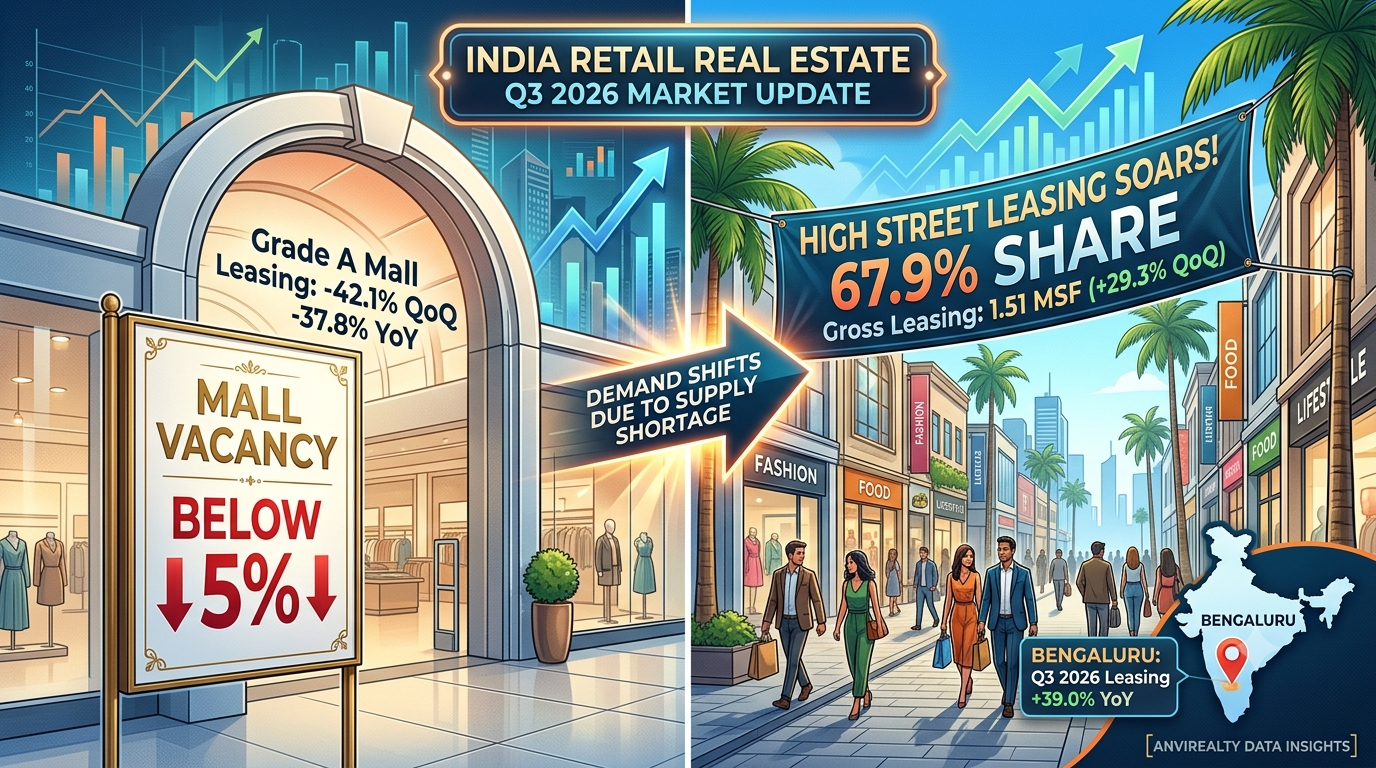
| Main street leasing | 1.51 MSF (67.9% share) | +29.3% QoQ, +33.1% YoY |
| Mall leasing | 0.71 MSF (32.1% share) | −42.1% QoQ, −37.8% YoY |
| Grade A mall vacancy | 4.8% | Down 20 bps from 5.0% in Q2 2026 |
| Prime high-street rents | — | +2.1% QoQ, +6.8% YoY (average) |
| New Grade A mall supply | Nil | Third consecutive quarter with none |
| Grade A mall pipeline | ~12.7 MSF through 2028 | ~1.35 MSF expected in 2026 |
The headline numbers point to a market that's constrained by supply rather than short of demand. Quarterly leasing dipped, but year-to-date volumes are effectively flat compared with 2025 — and that's with no new Grade A mall space coming online all year.
The Real Story: Demand Is Running Into a Space Shortage
The most telling figure in the report isn't the 2.22 MSF headline — it's the split between malls and main streets.
Mall leasing fell sharply, down 42.1% from the previous quarter to 0.71 MSF. At the same time, main street leasing rose 29.3% to 1.51 MSF, giving high streets roughly two-thirds of all retail leasing in the quarter.
Read alongside the vacancy data, this looks less like retailers abandoning malls and more like retailers being unable to find mall space. Grade A mall vacancy tightened to 4.8% — below 5% — and the market has now gone three straight quarters without any new Grade A mall completions. Cushman & Wakefield's own commentary makes the same point: limited availability of quality space is increasingly shaping how fast leasing can happen.
For brands that want to expand now, the high street has become the default option. That shift shows up in rents too: prime high-street rents rose an average of 2.1% quarter-on-quarter and 6.8% year-on-year. According to the report, the strongest annual increases among tracked high streets were on Chennai's Cathedral Road–RK Salai, Mumbai's Linking Road, Chembur and Fort/Fountain, and Delhi NCR's Khan Market.
City-by-City Leasing
Three markets — Delhi NCR, Hyderabad and Mumbai — accounted for 61% of the quarter's leasing between them.
| City | Q3 2025 (MSF) | Q2 2026 (MSF) | Q3 2026 (MSF) | QoQ | YoY | Share of Q3 2026 |
|---|---|---|---|---|---|---|
| Delhi NCR | 0.51 | 0.67 | 0.55 | −17.7% | +7.9% | 24.9% |
| Hyderabad | 0.38 | 0.37 | 0.45 | +22.0% | +18.3% | 20.3% |
| Mumbai | 0.59 | 0.50 | 0.35 | −29.5% | −40.8% | 15.7% |
| Bengaluru | 0.18 | 0.25 | 0.24 | −3.8% | +39.0% | 11.0% |
| Pune | 0.33 | 0.25 | 0.21 | −15.6% | −36.2% | 9.5% |
| Chennai | 0.16 | 0.20 | 0.18 | −8.7% | +12.1% | 8.3% |
| Ahmedabad | 0.11 | 0.11 | 0.13 | +18.6% | +15.8% | 5.7% |
| Kolkata | 0.06 | 0.05 | 0.10 | +113.5% | +68.8% | 4.6% |
| Total | 2.33 | 2.40 | 2.22 | −7.3% | −4.4% | 100% |
Source: Cushman & Wakefield, Q3 2026 Retail MarketBeat. City figures are rounded and may not sum exactly to the total.
A few patterns stand out:
- Hyderabad was the strongest large market, growing both quarter-on-quarter and year-on-year to take the number two spot.
- Mumbai and Pune saw the steepest annual declines, down roughly 41% and 36% respectively from Q3 2025.
- Kolkata more than doubled from the previous quarter, though from a small base of 0.05 MSF.
- Six of the eight cities were up year-on-year: Delhi NCR, Hyderabad, Bengaluru, Chennai, Ahmedabad and Kolkata all posted annual growth, while Mumbai and Pune declined.
Bengaluru: Small Quarterly Dip, Strong Annual Growth
Bengaluru recorded 0.24 MSF of retail leasing in Q3 2026, making it the fourth-largest market in the quarter with an 11.0% share of the eight-city total.
| Bengaluru | Value |
|---|---|
| Q3 2026 leasing | 0.24 MSF |
| Change vs Q2 2026 | −3.8% |
| Change vs Q3 2025 | +39.0% |
| Share of eight-city leasing | 11.0% |
The annual growth figure is the one to watch. At +39.0% year-on-year, Bengaluru posted the second-fastest annual growth of the eight cities, behind only Kolkata. Based on the report's own figures, Bengaluru's share of national leasing has risen from roughly 7.7% in Q3 2025 (0.18 of 2.33 MSF) to 11.0% in Q3 2026 — and it has moved up from fifth to fourth place among the eight cities over that period. (Share and ranking comparisons are AnviRealty calculations from the city table above.)
The quarter-on-quarter dip of 3.8% was the mildest decline among the cities that fell sequentially, suggesting Bengaluru's retail demand held relatively steady through the quarter.
Bengaluru's place in the supply pipeline
Cushman & Wakefield expects about 12.7 MSF of Grade A mall supply to be completed through 2028, and identifies Bengaluru as the second-largest contributor to that pipeline, after Delhi NCR and ahead of Chennai. The report doesn't break out a Bengaluru-specific figure, but the direction is clear: after a period of very limited new mall space, the city is set to see a meaningful wave of Grade A retail supply over the next two to three years.
Who's Leasing: Home-Grown Brands and Lifestyle Categories
Domestic retailers dominate
Domestic retailers accounted for 86.3% of Q3 2026 leasing (1.92 MSF), with international brands making up the remaining 13.7% (0.30 MSF). Cushman & Wakefield attributes this to continued expansion by home-grown brands, while noting that international retailers remain active in the premium and luxury segments.
Fashion, food and lifestyle lead
| Category | Share of Q3 2026 leasing |
|---|---|
| Fashion | 24.9% |
| Food & Beverage | 19.2% |
| Accessories & Lifestyle | 13.1% |
| Department Stores | 7.8% |
| Entertainment | 7.5% |
Fashion, F&B and Accessories & Lifestyle together made up 57.2% of leasing. The firm's retail head described demand as broad-based, pointing to newer retail concepts and the growth of home-grown brands as signs of an organised retail market that is still evolving.
What Comes Next: Supply Returns, Festive Demand Builds
Two forces are likely to shape the next few quarters.
Festive season demand. The report was released at the start of India's festive period, and Cushman & Wakefield expects strong consumption sentiment to support retailers through it.
The supply pipeline. About 1.35 MSF of Grade A mall space is expected to complete in 2026, with the balance of the roughly 12.7 MSF pipeline arriving through 2028. As that stock comes online, it should ease the current shortage and give brands more options to expand — potentially releasing demand that has been held back by the lack of space. Cushman & Wakefield also cautioned that new supply alone won't determine winners: location, quality, accessibility and the ability to offer a differentiated consumer experience will decide which malls attract tenants.
Why This Matters for Bengaluru Homebuyers and Investors
Retail real estate data isn't just relevant to brands and mall developers. It also says something about where residential demand and value may follow.
1. New Grade A malls tend to reshape micro-markets. Bengaluru's position as the second-largest contributor to the national mall pipeline through 2028 means several neighbourhoods are likely to gain a large organised retail anchor in the next few years. For homebuyers, proximity to a well-run mall typically brings everyday convenience, entertainment, and dining options; for investors, it can support rental demand. When evaluating a residential project, it's worth asking which retail developments are actually under construction nearby, and when they're scheduled to open — not just what's "proposed."
2. High-street strength reflects neighbourhood strength. The shift of leasing activity toward main streets, along with rising high-street rents, shows that established retail corridors in well-populated areas remain in demand. Residential locations with active, walkable high streets nearby tend to hold their appeal.
3. Experience-led retail is becoming the benchmark. Cushman & Wakefield's emphasis on tenant mix, experience and curation suggests the next generation of malls will be more than shopping centres. Integrated and mixed-use developments that combine housing with quality retail may become more attractive as consumer expectations rise.
4. For retail-focused investors, scarcity cuts both ways. Sub-5% Grade A mall vacancy and rising high-street rents favour existing, well-located retail assets today. But with roughly 12.7 MSF of new mall supply arriving through 2028, investors in retail property — directly or through listed retail REITs — should expect competition for tenants to intensify in the markets with the largest pipelines, including Bengaluru.
The Bottom Line
India's retail market in Q3 2026 wasn't short of tenants — it was short of quality space. Leasing slipped modestly on both a quarterly and annual basis, but year-to-date volumes are level with 2025 despite three consecutive quarters with no new Grade A malls. Retailers responded by moving to the high street, pushing up prime high-street rents.
For Bengaluru, the quarter was quietly strong: leasing up 39% year-on-year, a rising share of national activity, and a large slice of the coming mall pipeline. The next two to three years should bring considerably more Grade A retail space to the city — and with it, a shift in which neighbourhoods offer the best mix of residential and retail amenity.
References
- Cushman & Wakefield, "India's Retail Leasing Reaches 2.22 MSF in Q3 2026; Grade A Mall Vacancy Tightens to 4.8%: Cushman & Wakefield," press release, 1 October 2026. https://www.cushmanwakefield.com/en/india/news/2026/10/india-retail-sector-growth-in-q3-2026
- Cushman & Wakefield, India MarketBeat Reports. https://www.cushmanwakefield.com/en/india/insights/marketbeat-india
- Cushman & Wakefield, Bengaluru MarketBeat. https://www.cushmanwakefield.com/en/india/insights/marketbeat-india/bengaluru-marketbeat
All market figures in this article are taken from Cushman & Wakefield's Q3 2026 Retail MarketBeat press release (reference 1). Bengaluru's Q3 2025 share of leasing and city rankings are AnviRealty calculations based on the city-level figures published in that release. Analysis and commentary on implications for homebuyers and investors are AnviRealty's own and should not be attributed to Cushman & Wakefield.
This article is for informational purposes only and does not constitute investment advice.
Published by AnviRealty — Bengaluru's data-driven real estate advisory platform.