Home Loan Overdraft (OD) Products: How to Cut Interest Outgo Without Giving Up Liquidity
Most home loan borrowers face the same dilemma: prepay the loan to save interest, or keep cash aside for emergencies. Home loan overdraft products — such as SBI MaxGain, ICICI Bank Money Saver and Bank of Baroda Home Loan Advantage — let you do both. This guide explains how they work, when they save you money (and when they cost you more), and includes a worked case study comparing an OD home loan with a regular loan and with prepayment.
The Short Version
- An OD-linked home loan lets you park surplus money against your loan. Interest is charged only on the outstanding loan minus the money you've parked — but the parked money stays available to withdraw.
- It gives you the interest saving of a prepayment with the liquidity of a savings account. Whatever you park effectively "earns" your home loan interest rate, and because it's an interest saving rather than income, it isn't taxed the way FD or savings interest is.
- There's usually a cost. Many lenders price OD variants slightly above their regular home loan rate. If you don't keep enough money parked, you end up paying more than you would on a regular loan.
- The rule of thumb: an OD home loan makes sense only if the balance you can keep parked, on average, comfortably exceeds the break-even level — roughly (rate premium ÷ OD loan rate) × outstanding loan. For a 0.25 percentage point premium on an 8.25% loan, that's about 3% of the outstanding amount.
- Discipline matters. The same feature that makes OD loans useful — easy withdrawals — can make it tempting to spend the money parked against your loan.
The Borrower's Dilemma: Prepay or Keep Cash?
Picture a typical salaried borrower in Bengaluru with a ₹60 lakh home loan. They also have ₹5 lakh in savings set aside as an emergency fund, and receive an annual bonus.
They have two traditional choices:
- Keep the money in a savings account or FD. It stays accessible, but earns a return that's typically lower than the home loan rate — and the interest is taxable.
- Prepay the home loan. This saves interest at the full loan rate, but the money is gone. If a medical emergency or job loss happens next year, getting it back means taking another loan, often at a higher rate.
An OD-linked home loan is designed to remove that trade-off.
How Home Loan OD Products Work
The basic mechanism
With an OD-linked home loan, your loan is connected to an account where you can park money — your salary, savings, bonuses, or any other surplus. Every day, the bank calculates interest only on:
Outstanding loan − Balance parked in the linked account
Example: If your outstanding loan is ₹50 lakh and you have ₹5 lakh parked, you pay interest as though the loan were ₹45 lakh. If you need ₹2 lakh for an emergency, you withdraw it — and from that day, interest is calculated on ₹47 lakh instead.
You continue paying your regular EMI. Because the interest component is lower whenever you have money parked, more of each EMI goes toward the principal, so the loan is repaid faster.
Three different structures — know which one you're getting
Not every product marketed as a "home loan overdraft" works the same way. Broadly, there are three structures in the Indian market:
1. The loan itself is an overdraft account (e.g., SBI MaxGain) The home loan is sanctioned as an overdraft. You pay EMIs as usual, and the account's drawing power — the maximum you can draw — reduces every month in line with the principal component of the EMI, so that the overdraft is fully repaid by the end of the tenure. Surplus you deposit reduces the balance on which interest is charged, and you can withdraw it as long as you stay within the drawing power.
2. A term loan linked to a savings or current account (e.g., ICICI Bank Money Saver, Bank of Baroda Home Loan Advantage, Bank of Maharashtra Maha Super Flexi) You have a regular home loan and a separate linked account. The balance in that linked account at the end of each day is offset against the loan outstanding when calculating interest. The linked account itself typically earns no interest — your "return" is the interest you save on the loan.
3. A credit line or overdraft on top of a home loan (e.g., ICICI Bank Home Overdraft) This is a different kind of product. It's an approved borrowing limit, secured against your property, that you can draw on when you need funds — and you pay interest only on the amount you actually use, for the period you use it. It's primarily a liquidity tool for borrowing, not a way to save interest on your existing home loan.
Types 1 and 2 are the interest-saving products this article focuses on. Type 3 is useful to know about, but it solves a different problem.
Product Snapshot: What Indian Banks Offer
Interest rates on these products change frequently and depend on your credit profile, loan amount and employment type, and third-party websites often show conflicting figures. The table below compares structure and features only. Always confirm the current rate — and any premium over the bank's regular home loan rate — directly with the lender.
| Product | Bank | Structure | How surplus reduces interest | Points worth noting |
|---|---|---|---|---|
| SBI MaxGain | State Bank of India | Home loan sanctioned as an overdraft | Surplus deposited in the overdraft account reduces the balance on which interest is charged | Drawing power reduces monthly by the principal component of the EMI; account works like a transactional account; minimum loan amount commonly reported as ₹20 lakh |
| ICICI Bank Money Saver | ICICI Bank | Home loan with a linked Money Saver account | Surplus kept in the Money Saver account reduces interest on the home loan | Funds can be withdrawn at any time, per the bank |
| Baroda Home Loan Advantage | Bank of Baroda | Home loan linked to a savings account | End-of-day credit balance in the linked savings account is treated as a credit to the home loan account | Linked savings account carries a zero interest rate; EMIs recovered from the linked account |
| Maha Super Flexi Housing Loan | Bank of Maharashtra | Term loan linked to a "flexi home" savings account | Day-end balances of the loan and linked account are netted for interest calculation | Interest rate on the linked savings account is zero |
| ICICI Bank Home Overdraft (credit line — different purpose) | ICICI Bank | Overdraft limit linked to a savings account, alongside a term loan | Not an interest-saving offset; interest is charged only on the amount drawn | Designed for flexible access to funds; sweep-in and reverse-sweep facility with the savings account |
Several other lenders, including HDFC Bank, Kotak Mahindra Bank and Axis Bank, are reported to offer OD-style or savings-linked home loan variants. Product names, eligibility and terms vary, so ask your lender specifically how the interest offset is calculated before signing.
Case Study: Regular Loan vs OD Loan vs Prepayment
To show how the numbers actually play out, here's an illustrative comparison.
Assumptions
| Parameter | Value |
|---|---|
| Loan amount | ₹60 lakh |
| Tenure | 20 years |
| Regular home loan rate | 8.00% |
| OD home loan rate | 8.25% (assumes a 0.25 percentage point premium) |
| Surplus available | ₹5 lakh, kept as an emergency fund |
| Alternative return on surplus | FD at 6.5%, taxed at 30% (≈4.55% post-tax) |
These are illustrative assumptions chosen to demonstrate the mechanics — they are not quotes for any specific bank's product. Calculations are by AnviRealty using a monthly approximation; banks calculate interest on daily balances, so actual figures will differ slightly.
Scenario results
| Scenario | EMI | Total interest paid | Time to close loan |
|---|---|---|---|
| A. Regular loan, ₹5 lakh kept in FD | ₹50,186 | ₹60.45 lakh | 20 years |
| B. OD loan, nothing parked | ₹51,124 | ₹62.70 lakh | 20 years |
| C. OD loan, ₹5 lakh parked throughout | ₹51,124 | ₹45.41 lakh | ~16 years 5 months* |
| D. Regular loan, ₹5 lakh prepaid upfront (EMI unchanged) | ₹50,186 | ₹44.07 lakh | ~16 years 6 months |
| E. OD loan, ₹5 lakh parked + ₹2 lakh added every year | ₹51,124 | ₹26.89 lakh | ~10 years 2 months* |
*In scenarios C and E, the loan is closed at the point where the outstanding balance falls to the level of the money parked, using the parked funds.
What the case study shows
1. An OD loan with nothing parked costs you more. Scenario B pays about ₹2.25 lakh more interest than the regular loan, purely because of the higher rate. If you won't actually park money, choose a regular loan.
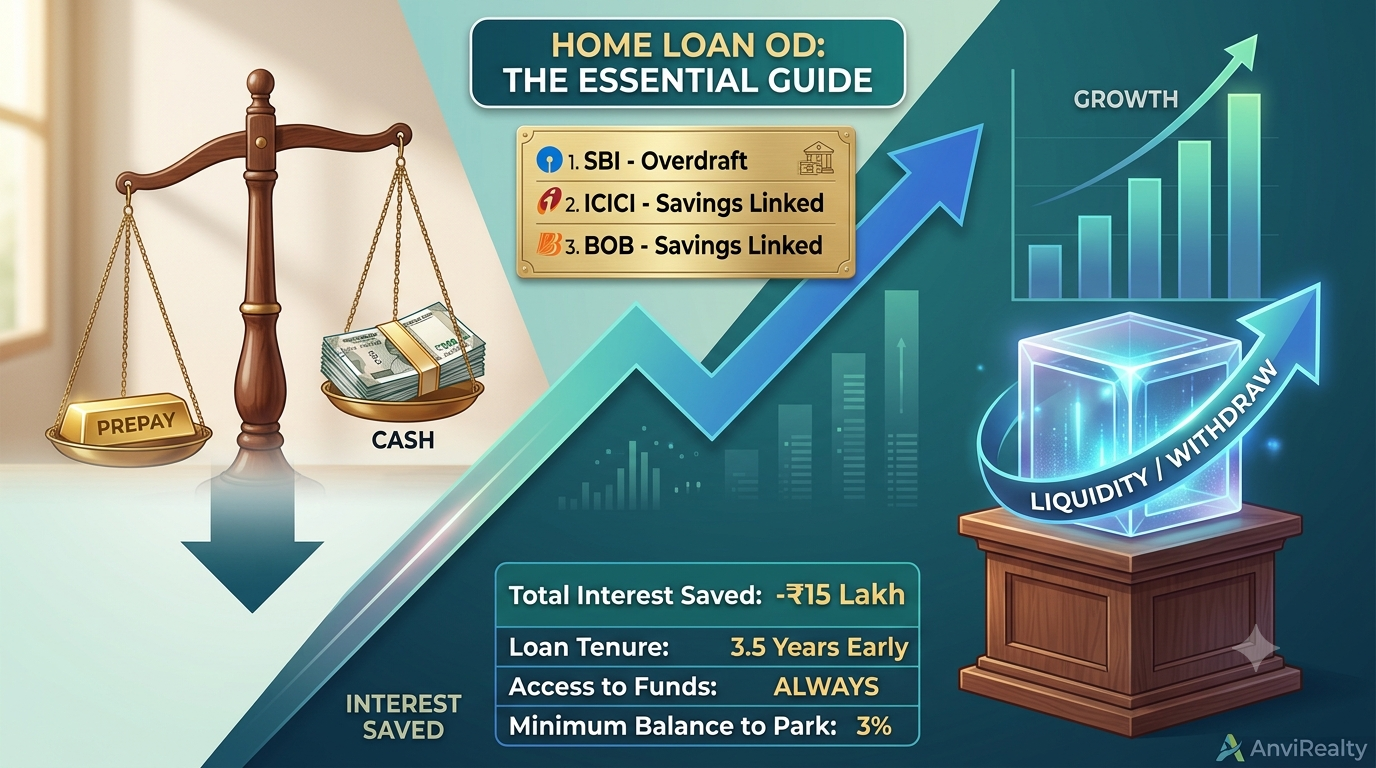
2. Parking ₹5 lakh saves about ₹15 lakh in interest. Scenario C cuts total interest from ₹60.45 lakh to ₹45.41 lakh and closes the loan roughly three and a half years early — while the ₹5 lakh remains available for emergencies the entire time.
3. Prepayment saves slightly more — but you lose the money. Scenario D saves marginally more interest than C, at about ₹44.07 lakh, because it uses the lower regular rate. The difference — roughly ₹1.3 lakh over 20 years — is effectively the price of keeping that ₹5 lakh accessible. For most families, that's a reasonable price for a full-sized emergency fund that never stops working.
4. Regularly adding surplus transforms the outcome. In Scenario E, parking an additional ₹2 lakh a year — say, from annual bonuses — brings total interest down to about ₹26.89 lakh and closes the loan in around 10 years instead of 20.
Comparing the end result
A cleaner way to compare scenario A and C is to look at where the borrower stands financially at the end of 20 years, assuming that in each case any spare cash is invested in an FD at 4.55% post-tax, including the EMIs freed up after the OD loan closes early.
| Regular loan + ₹5 lakh in FD | OD loan with ₹5 lakh parked | |
|---|---|---|
| Wealth at end of year 20 (illustrative) | ~₹16.1 lakh | ~₹24.2 lakh |
On these assumptions, the OD route leaves the borrower about ₹8 lakh better off after 20 years. If the alternative for the surplus was a savings account at 2.75% (taxed at 30%) rather than an FD, the advantage rises to about ₹13 lakh.
The Break-Even Rule: Will an OD Loan Work for You?
Because OD products often carry a rate premium, they only pay off if you keep enough money parked. The break-even point is approximately:
Break-even parked balance ≈ (Rate premium ÷ OD loan rate) × Outstanding loan
| Rate premium | OD loan rate | Break-even parked balance (as % of outstanding loan) | On a ₹60 lakh outstanding |
|---|---|---|---|
| 0.10 percentage point | 8.10% | ~1.2% | ~₹0.74 lakh |
| 0.25 percentage point | 8.25% | ~3.0% | ~₹1.82 lakh |
| 0.50 percentage point | 8.50% | ~5.9% | ~₹3.53 lakh |
AnviRealty calculations. The rates are illustrative.
How to use it: Find out the actual premium your bank charges for its OD variant over its regular home loan. If the average balance you can realistically keep parked is well above the break-even level, the OD product is likely to save you money. If it's close to or below it, a regular loan with occasional prepayments may be cheaper. If the lender charges no premium at all, any balance you park is pure saving.
How to Get the Most Out of an OD Home Loan
1. Route your salary through the linked account. Because interest is calculated on daily balances, crediting your salary into the OD or linked account — and spending from it through the month — reduces interest even on money you'll eventually spend.
2. Treat it as your emergency fund. Keeping your emergency reserve parked against the loan means it's always working for you while remaining available.
3. Park bonuses, incentives and windfalls. These can sit in the account indefinitely, lowering interest, until you need them — or permanently, which effectively becomes a prepayment.
4. Understand the drawing power. On products like SBI MaxGain, the maximum you can withdraw reduces every month. Over time, you can't withdraw beyond the reduced limit, so don't assume the full original amount stays available.
5. Set your own withdrawal rules. The ease of withdrawal is both the main advantage and the biggest risk. Decide in advance what counts as a legitimate reason to withdraw — and stick to it.
6. Revisit the decision periodically. If your surplus shrinks or your bank's OD premium rises relative to the market, compare your effective cost with a regular loan from the same or another lender.
Tax Points to Keep in Mind
- The interest you save isn't taxable. Parking money against your loan reduces an expense rather than generating income, so there's no tax on the benefit — unlike interest from an FD or savings account.
- It can reduce your home loan interest deduction. If you claim the deduction for interest on a self-occupied home — capped at ₹2 lakh a year and not available under the new tax regime — lower interest payments could reduce the deduction. On larger loans, though, the interest paid in the early years often exceeds ₹2 lakh even with money parked, so the cap still applies and you lose nothing. Check your own numbers, especially later in the loan when interest falls.
- Prepayment charges: For floating-rate home loans taken by individuals, lenders generally don't levy prepayment or foreclosure charges. Even so, confirm the terms of your specific loan.
Who Should — and Shouldn't — Choose an OD Home Loan
OD home loans tend to suit:
- Salaried borrowers with meaningful savings or annual bonuses who want to keep an emergency fund accessible
- Self-employed professionals and business owners with irregular cash flows, who can park money during good months and draw on it during lean ones
- Borrowers who would otherwise keep large balances idle in a savings account
- People who want the option to prepay without giving up liquidity
OD home loans may not suit:
- Borrowers with little or no surplus, who would pay the rate premium without any offsetting benefit
- People who find it hard to resist easily accessible money
- Borrowers whose surplus is better invested elsewhere — for example, someone comfortable with a long-term equity allocation whose expected post-tax return exceeds the home loan rate, and who doesn't need that money to be liquid
- Smaller loans, where the minimum loan amount for some OD products may not be met
Questions to Ask Your Bank Before Choosing an OD Home Loan
- What is the interest rate on the OD variant compared with your regular home loan, for my profile?
- Is the interest offset calculated on daily balances?
- Does the linked account earn any interest? (In most offset-type products, it doesn't.)
- How does drawing power reduce over time, and how much can I withdraw at any point?
- Are there any charges for deposits, withdrawals, debit cards or cheque books on the account?
- Is there a minimum loan amount, and are there restrictions on property type — for example, ready-to-move versus under-construction?
- Can I switch an existing regular home loan to the OD variant, and at what cost?
- Are there any annual renewal or maintenance charges on the overdraft facility?
Frequently Asked Questions
Q: How does a home loan overdraft save interest? Interest is calculated each day on the outstanding loan minus the balance parked in the linked or overdraft account. Every rupee you park reduces the interest-bearing balance for as long as it stays there.
Q: Is the money I park against the loan locked in? No. In offset-type OD products, you can withdraw the parked money when you need it, subject to the account's drawing power or terms. That's the main advantage over a prepayment.
Q: Is an OD home loan always cheaper than a regular home loan? No. Many OD variants carry a small rate premium. If you don't keep enough money parked, you'll pay more interest than on a regular loan. Use the break-even rule above.
Q: Is parking money in an OD account better than prepaying? Prepaying usually saves slightly more interest, especially if the OD variant has a higher rate. The OD option gives up a small amount of saving in exchange for keeping the money accessible.
Q: Does the money in the linked account earn interest? Usually not. In most offset-type products, the linked account carries no interest; your return is the interest you save on the loan, at the home loan rate.
Q: What's the difference between SBI MaxGain and ICICI Home Overdraft? SBI MaxGain is a home loan sanctioned as an overdraft, designed to reduce interest on your home loan when you park surplus funds. ICICI Bank Home Overdraft is a credit line linked to your savings account, alongside a term loan, where you pay interest only on the amount you draw — it's primarily a way to access funds, not to save interest on an existing loan. ICICI's interest-saving product is Money Saver.
Q: Can I convert my existing home loan into an OD home loan? Many lenders allow conversion within the same bank or through a balance transfer to a lender offering an OD variant. Ask about any charges, documentation and the new rate before switching.
Final Word
A home loan overdraft is one of the most practical tools available to Indian borrowers: it lets your emergency fund, salary and bonuses reduce your interest cost every day, without locking that money away. In our illustrative case study, simply parking a ₹5 lakh emergency fund against a ₹60 lakh loan cut total interest by around ₹15 lakh and closed the loan about three and a half years early.
But it isn't automatically the right choice. The benefit depends entirely on keeping enough money parked to outweigh any rate premium — and on the discipline not to treat the account as spending money. Ask your bank for the exact premium, run the break-even calculation, and choose the OD route only if your realistic average surplus clears it comfortably.
Do Checkout AnviRealty's Home Loan OD Calculator for better view of the numbers https://www.anvirealty.in/home-loan-od-calculator
References
- State Bank of India, SBI MaxGain product description (as quoted in StableInvestor, "SBI MaxGain Home Loan: Benefits, Features & Review (2026)"). https://stableinvestor.com/2022/03/sbi-maxgain-home-loan-benefits-review.html
- ICICI Bank, Money Saver Home Loan (product page). https://www.icici.bank.in/ms/homeloan/landingpages/Moneysaverhomeloan.html
- ICICI Bank, "Home Loan with a Fixed Deposit or Money Saver Home Loan? Choose Wisely" (blog). https://www.icici.bank.in/blogs/home-loan/money-saver-home-loan
- ICICI Bank, Home Overdraft (product page). https://www.icici.bank.in/personal-banking/loans/home-loan/home-overdraft
- ICICI Bank, "ICICI Bank launches home loan overdraft for salaried customers" (press release, 2016). https://www.icici.bank.in/about-us/news-room/2016/news-icici-bank-launches-home-loan-overdraft-for-salaried-customers
- ICICI Bank, "Everything about Home Loan with Overdraft Facility" (blog). https://www.icici.bank.in/personal-banking/blogs/loan/home-loan/home-loan-overdraft
- Bank of Maharashtra, Maha Super Flexi Housing Loan Scheme. https://bankofmaharashtra.bank.in/maha-super-flexi-housing-loan-scheme
- BankBazaar, Bank of Baroda Home Loan Advantage (features summary). https://www.bankbazaar.com/home-loan/bank-of-baroda-home-loan-advantage.html
- BankBazaar, SBI MaxGain Home Loan (features summary). https://www.bankbazaar.com/sbi-maxgain-home-loan.html
Product features are based on the sources above and may change. The case study and break-even figures are AnviRealty calculations using illustrative interest rates and a monthly approximation; they are not offers or quotes from any bank. Banks calculate interest on daily balances, and actual savings will depend on the rate you're offered, your balances and your bank's terms.
This article is for general information only and does not constitute financial or tax advice. Consult your lender and a qualified financial advisor before choosing a home loan product.
Published by AnviRealty — Bengaluru's data-driven real estate advisory platform.