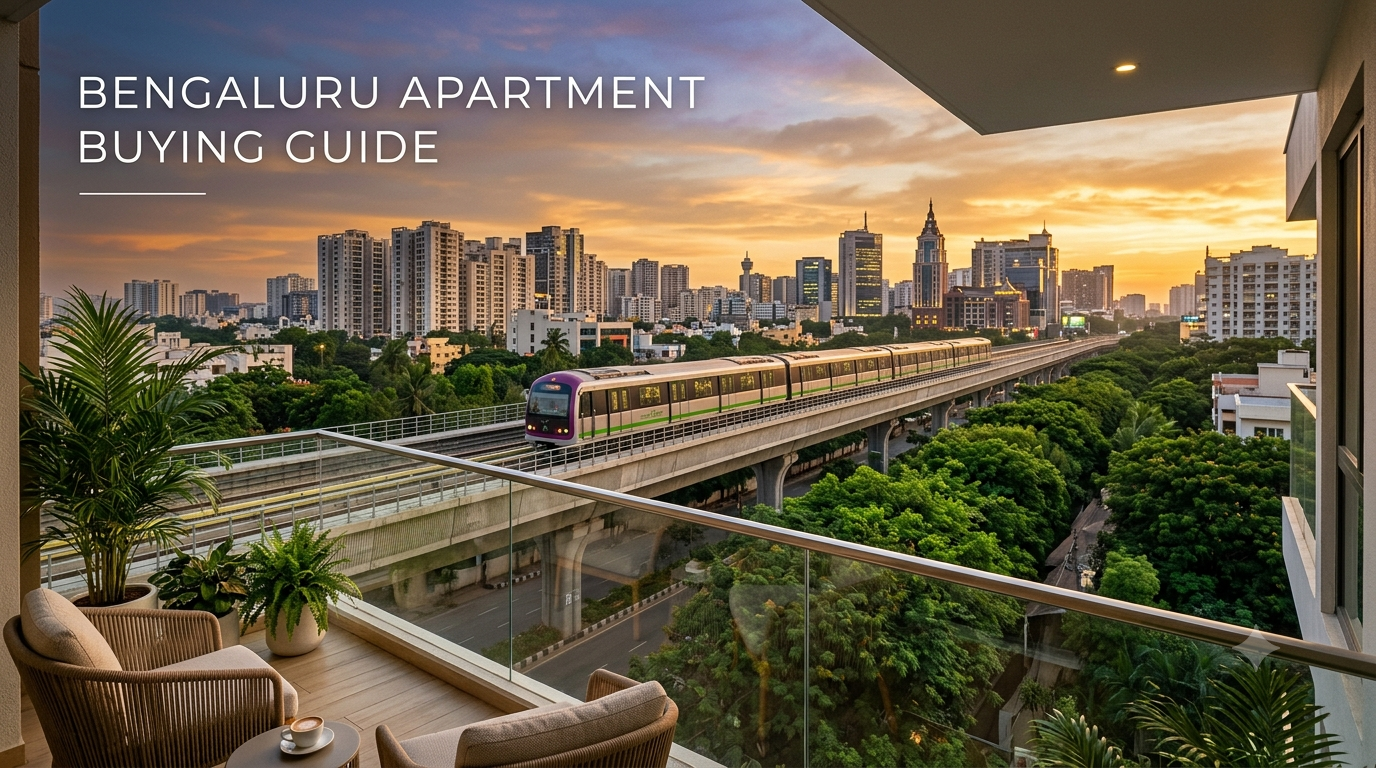
Buying an Apartment in Bengaluru: What to Look for in the Home and the Community
Most apartment buyers in Bengaluru spend weeks comparing price per sq ft and amenity lists — and minutes on the things that actually decide whether they'll be happy living there in five years. This guide covers what to check in the apartment itself, in the building and community around it, and in the neighbourhood — with the Bengaluru-specific issues that brochures rarely mention.
The Short Version
When you're shortlisting an apartment in Bengaluru, evaluate it at four levels:
- The paperwork — RERA registration, Occupancy Certificate, Khata status, and title. If these aren't right, nothing else matters.
- The home — usable carpet area, layout, light and ventilation, orientation, floor, and build quality.
- The building and community — density, open space, water source, maintenance, the residents' association, and how the amenities are actually run.
- The neighbourhood — your real commute, social infrastructure, flooding risk, and the infrastructure that's genuinely coming versus just announced.
The sections below walk through each, with what to ask and what to watch out for.
Part 1: Start With the Paperwork
It's tempting to skip straight to the floor plan. Don't. In Bengaluru, a well-designed apartment with a paperwork problem can be impossible to finance, difficult to register, and hard to resell.
RERA registration
For under-construction projects, check the project on the Karnataka RERA portal (rera.karnataka.gov.in). Confirm that:
- the project and the specific phase or tower you're buying in are registered
- the promoter name matches the developer you're dealing with
- the carpet area, number of units, and declared completion date match what you've been told
- there are no significant complaints against the project or promoter
RERA also gives you specific protections worth knowing:
- Carpet area pricing: Under RERA, apartments must be sold on the basis of carpet area — the net usable floor area within the walls.
- Limits on advances: A promoter cannot take more than 10% of the apartment cost as an advance or application fee before a registered agreement for sale is executed.
- Escrow protection: 70% of amounts collected from buyers must be held in a separate account and used only for that project's land and construction costs.
- Five-year defect liability: Structural defects and defects in workmanship, quality, or services reported within five years of possession must be rectified by the promoter at no cost.
Occupancy Certificate (OC)
For a ready-to-move-in apartment, the Occupancy Certificate is non-negotiable. It confirms the building was constructed as per the approved plan and is fit for occupation. Without an OC, you can face difficulties with permanent water and electricity connections, home loans, and resale.
For an under-construction apartment, ask what approvals are in place today and when the developer expects the OC.
Khata and e-Khata
Check whether the land and building hold an A-khata or B-khata. B-khata properties are typically harder to finance and resell. Since October 2024, a valid e-Khata has also been required to register a property in Bengaluru. For a resale flat, ask for the seller's final, verified e-Khata — not just a draft.
Title and land history
Have an independent property lawyer review:
- the title chain, typically going back 30 years
- the Encumbrance Certificate
- for land previously in agricultural use, the conversion order to non-agricultural use
- whether the project was built under a Joint Development Agreement, and what that means for the land title
Jurisdiction
Bengaluru is now governed by the Greater Bengaluru Authority and five city corporations. Many newer projects on the city's edges sit outside these limits and fall under other local bodies. Confirm which authority approved the building plan and which one will handle your khata and property tax.
Part 2: What to Look for in the Apartment Itself
Carpet area, not just "size"
Developers often quote a super built-up area that includes walls, common areas like lobbies and corridors, and a share of the clubhouse. What you actually live in is the carpet area. The gap between the two — often called "loading" — varies significantly between projects.
What to do: Compare projects on price per sq ft of carpet area, not super built-up area. A project that looks cheaper on a super built-up basis can turn out to be more expensive once you compare usable space.
Layout efficiency
A well-planned 1,200 sq ft apartment can feel larger than a poorly planned 1,400 sq ft one. Look for:
- Minimal wasted space in long corridors or awkward passages
- Usable room shapes — rectangular rooms are easier to furnish than angled ones
- Bedroom privacy — bedrooms not opening directly into the living room
- A practical kitchen — enough counter length, space for a fridge, and a separate utility area for a washing machine and drying
- Sensible toilet placement — at least one common toilet accessible without entering a bedroom
- Balconies you'll actually use — a deep, usable balcony is worth more than several narrow ones
Natural light and ventilation
This is one of the hardest things to fix after you move in, and one of the most important for daily comfort.
- Cross-ventilation: Ideally, the living area and bedrooms have windows on more than one side, allowing air to flow through.
- Units per floor: Fewer units per floor generally means more exterior walls and windows for each apartment. Apartments in the middle of a long row of units often get light from only one side.
- "Corner" and "no common wall" layouts typically offer better light, ventilation and privacy.
- Overlooking: Check how close the nearest tower is and whether your windows face directly into a neighbour's.
What to do: Visit the actual unit, or a unit on a similar floor and facing, at different times of day. A sample flat on the ground floor of a sales office isn't a substitute.
Orientation and facing
Many Bengaluru buyers have preferences on facing — East or North facing for traditional or Vastu reasons, for example. Beyond personal preference, orientation affects:
- how much morning or afternoon sunlight the home gets
- how warm the west-facing rooms get in the afternoon
- how much light reaches the balcony and living area
There's no universally "right" answer, but understand the trade-offs before paying a premium for a particular facing.
Floor choice
| Consideration | Lower floors | Higher floors |
|---|---|---|
| Lift dependency | Low | High |
| Road noise and dust | Higher | Lower |
| Views and privacy | Limited | Better |
| Light | Can be blocked by surrounding buildings | Usually better |
| Price | Often lower | Often carries a floor-rise premium |
| Ease for elderly residents | Easier | Depends on lift reliability |
Build quality and specifications
Ask for the specification sheet in writing and check:
- Structural system — for example, RCC framed or shear wall construction
- Flooring, sanitaryware and fittings — brands and grades, ideally specified rather than "or equivalent" alone
- Electrical provisions — points for AC in every bedroom, sufficient sockets, and earth leakage protection
- Doors and windows — material and glazing
- Waterproofing — particularly in bathrooms, balconies and the terrace
For ready apartments, inspect for cracks, dampness, hollow-sounding tiles, slow drains and uneven floors before you commit — and again before you take handover.
Parking
- Is parking included, or charged separately?
- Is the slot allotted (a specific, numbered space) or just "available"?
- Is it covered or open, and is it a single or tandem slot?
- Is there provision for EV charging at your slot, or at least electrical capacity for it?
Part 3: What to Look for in the Building and Community
Your apartment is only as good as the building and community it's part of. These factors shape your daily life and the property's long-term value — and many of them can't be changed once you've moved in.
Density and open space
- Units per acre: A project with fewer homes per acre generally means less crowding of amenities, less traffic inside the campus, and more breathing room.
- Open space: Developers often quote an open space percentage. Ask what it includes — landscaped green areas and play spaces are very different from driveways and paved surfaces.
- Tower spacing: Generous gaps between towers improve privacy, light, and airflow.
Water: the most important Bengaluru question
Water availability is one of the most significant liveability factors in Bengaluru. Ask directly:
- Does the building have a BWSSB (Cauvery) connection, or is one sanctioned? Get this in writing.
- If not, what is the water source? Borewells, tankers, or a combination?
- What do residents currently spend on tanker water, if applicable? For a resale flat, ask the residents' association.
- Is there a functioning sewage treatment plant (STP) and is treated water reused, for example for flushing and landscaping?
- Is rainwater harvesting installed and working?
A building dependent on tankers can add a significant recurring cost and uncertainty, especially in dry summers.
Power backup
- Is backup provided for common areas (lifts, pumps, corridor lighting)?
- How much backup is allocated to each apartment, and does it cover essentials like lights, fans and the fridge?
Lifts
- How many lifts serve each tower, and how many units per floor do they serve?
- Is there a separate service lift for moving furniture and deliveries?
- In occupied buildings, ask about lift breakdowns and maintenance response times.
Amenities: delivered, functional, and affordable to run
An amenity list with 80+ items looks impressive on a brochure. What matters is:
- Which amenities actually exist — or, for under-construction projects, which will be ready at possession versus in a later phase
- Whether they're used and maintained — an empty, poorly maintained clubhouse is a cost without a benefit
- What they cost to run — large clubhouses, pools and landscaped areas all add to monthly maintenance
What to do: Get the maintenance charge per sq ft in writing, along with any one-time corpus or sinking fund amounts payable at possession.
The residents' association and how the community is run
This is one of the most overlooked factors, and one of the most important for long-term quality of life.
- Has the association been formed? RERA requires the promoter to enable formation of an association of allottees within three months of a majority of units being booked.
- Who manages the property today — the developer, a facility management company, or the association?
- Have the common areas been handed over to the association? RERA requires the promoter to hand over common areas to the association; where local law doesn't specify a timeline, this must be done within three months of the Occupancy Certificate.
- Is there a corpus fund, and how is it managed?
For resale apartments, ask the association for:
- the current monthly maintenance charges and any planned increases
- recent minutes or notices, which reveal ongoing disputes or major repair needs
- any pending litigation involving the developer or the building
- the condition of the reserve or sinking fund for major repairs
A well-run association is a strong sign of a well-maintained property. A dysfunctional one — or an ongoing dispute with the developer — can affect everything from water supply to lift maintenance.
Community profile and rules
- Owner-occupied versus rented: A predominantly owner-occupied community often has more engaged residents. A largely rented one may have higher turnover.
- Families, children and seniors: If you have young children or elderly family members, check play areas, walking paths, accessibility and nearby healthcare.
- Pet policy: If you have pets, ask about building rules and facilities.
- Rules on interiors and renovations: Some associations have restrictions on work hours or structural changes.
Security and safety
- Gated access, visitor management and 24/7 security
- CCTV coverage of entrances and common areas
- Fire safety systems — sprinklers, fire alarms, extinguishers and clear fire exits — and the building's fire NOC
- For families with children, safety features like balcony railing height and pool supervision
Part 4: What to Look for in the Neighbourhood
Your real commute
Bengaluru commute times vary dramatically by time of day. A 12 km drive can take 25 minutes on a Sunday morning and over an hour on a weekday evening.
What to do: Drive or travel your actual route at your actual peak hours before you buy. Don't rely on distances or travel times in brochures.
Metro: operational vs approved vs proposed
Metro connectivity can significantly improve daily life and property values — but only when it's running. Before you pay a premium for "metro proximity," find out whether the line is:
- Operational — you can use it today
- Under construction — likely to arrive, but timelines often slip
- Approved or proposed — potentially years away
Social infrastructure
- Schools — not just distance, but the actual commute time at school hours
- Hospitals — proximity to a good multi-specialty hospital matters, particularly for families with elderly members
- Daily needs — grocery stores, pharmacies, and markets within a short distance
- Retail and leisure — malls and high streets nearby add convenience, and active high streets often signal a healthy neighbourhood
Flooding and drainage
Some Bengaluru localities, particularly low-lying areas and those near lakes and stormwater drains (rajakaluves), have experienced flooding during heavy rains.
What to do:
- Check whether the project or the roads leading to it have flooded in recent monsoons — ask local residents, and search local news
- Check proximity to lakes and stormwater drains, and whether the project respects the required buffer zones — encroachment of these zones has led to enforcement action in Bengaluru
- Look at the project's own drainage design, basement waterproofing and the level of the site relative to the surrounding road
Environmental and nuisance factors
Things that are easy to miss on a weekend site visit:
- Noise from highways, railway lines, flight paths or nearby industrial units
- High-tension power lines running near the site
- Garbage processing sites or landfills in the vicinity
- Industrial areas with possible odour or air quality issues
- Construction around the project — large vacant plots nearby may mean years of construction noise and dust
Future development around you
Look at what's planned nearby:
- Road widening, flyovers, or ring roads — which can improve access but also bring construction disruption and noise
- Large commercial or residential projects that will add traffic
- Vacant land that could be developed and block your view or light
Resale and rental potential
Even if you're buying to live in, it's worth thinking about whether the apartment will be easy to rent or sell later. Properties close to employment hubs, with good connectivity, a reputed developer, clean paperwork and a well-run community generally hold their appeal best.
Red Flags to Walk Away From (or Investigate Thoroughly)
- No RERA registration for an under-construction project
- No Occupancy Certificate for a project being sold as "ready to move in"
- B-khata, or unclear khata status, without a clear and costed conversion path
- A developer insisting on a large payment before signing a registered agreement for sale
- Vague or verbal-only commitments on water connection, parking, amenities, or possession dates
- A developer reluctant to share approvals, the specification sheet, or the RERA-registered carpet area
- Significant unresolved complaints or litigation against the developer or project
- Persistent flooding history in the area
- An existing building with a dysfunctional residents' association or an ongoing dispute with the developer
- Price per sq ft that's significantly below the local market without a clear explanation
A Practical Visit Checklist
Take this with you on site visits:
Paperwork
- RERA number verified on the Karnataka RERA portal
- OC available (ready flats) or approval status clear (under-construction)
- A-khata / e-Khata status confirmed
- Title documents reviewed by an independent lawyer
The home
- Carpet area confirmed in writing
- Layout checked for wasted space and room usability
- Light and ventilation checked at the actual unit or a comparable one
- Facing and floor confirmed
- Specification sheet received in writing
- Parking allotment confirmed
The building and community
- Water source confirmed (BWSSB connection, borewell, tankers)
- STP and rainwater harvesting checked
- Power backup allocation confirmed
- Lifts per tower and units per floor checked
- Amenities delivery timeline and maintenance charges confirmed in writing
- Residents' association status and common area handover checked
- For resale: association contacted about charges, disputes and repairs
The neighbourhood
- Commute tested at peak hours
- Metro status confirmed as operational, under construction, or proposed
- Schools, hospitals and daily needs checked
- Flooding history checked
- Nearby nuisances checked (noise, power lines, waste sites, industry)
Frequently Asked Questions
Q: What's the single most important thing to check when buying an apartment in Bengaluru? Paperwork comes first: RERA registration for under-construction projects, the Occupancy Certificate for ready ones, and clean title with A-khata status. A great apartment with a legal problem can be impossible to finance, register or resell.
Q: Should I compare apartments on carpet area or super built-up area? Always compare on carpet area. Under RERA, apartments must be sold on the basis of carpet area, and the gap between carpet and super built-up area varies widely between projects.
Q: How important is the water source? In Bengaluru, it's one of the most important practical factors. A building with a BWSSB (Cauvery) connection is generally more reliable than one dependent on borewells or tankers, which can add significant recurring costs.
Q: Ready-to-move or under-construction? Ready-to-move apartments let you see exactly what you're buying, avoid construction delays, and don't attract GST if the OC has been issued. Under-construction apartments are often priced lower but carry delivery risk and GST. Choose based on your budget, timeline and risk tolerance.
Q: How can I find out what the community is really like? Visit at different times of day, speak to residents, and for existing buildings, contact the residents' association. Ask about maintenance, water, lift performance, security and any disputes with the developer.
Q: Is a higher floor always better? Not necessarily. Higher floors usually offer better views, light and less road noise, but depend more on lifts and often carry a floor-rise premium. Lower floors are easier for elderly residents and during power cuts or lift breakdowns.
Q: Should I pay more to be near a metro station? Only if you're confident about the timeline. An operational metro line adds real value; a proposed or approved line may be years away.
Final Word
The right apartment in Bengaluru isn't just the one with the best price per sq ft or the longest amenity list. It's the one with clean paperwork, a well-designed and well-lit home, a reliable water supply, a well-run community, and a commute you can live with every day.
Most of these things are easy to check before you buy and very difficult to change after you move in. Spend the time on site visits at different hours, talk to residents, get commitments in writing, and have an independent lawyer review the documents. It's the most valuable time you'll spend in the entire buying process.
References
- Real Estate (Regulation and Development) Act, 2016 — including Section 2(k) (carpet area), Section 4(2)(l)(D) (70% escrow), Section 11(4)(e) (formation of association), Section 13 (limit on advance payment), Section 14(3) (five-year defect liability), and Section 17 (conveyance and handover of common areas).
- Karnataka Real Estate Regulatory Authority — https://rera.karnataka.gov.in
- e-Aasthi portal (e-Khata), Greater Bengaluru Authority — https://bbmpeaasthi.karnataka.gov.in
This article is for general information only and does not constitute legal or financial advice. Consult a qualified property lawyer before making a purchase decision.
Published by AnviRealty — Bengaluru's data-driven real estate advisory platform.