India's Data Centre Boom (H1 2026): What It Means for Bengaluru Real Estate — and Where It's Happening
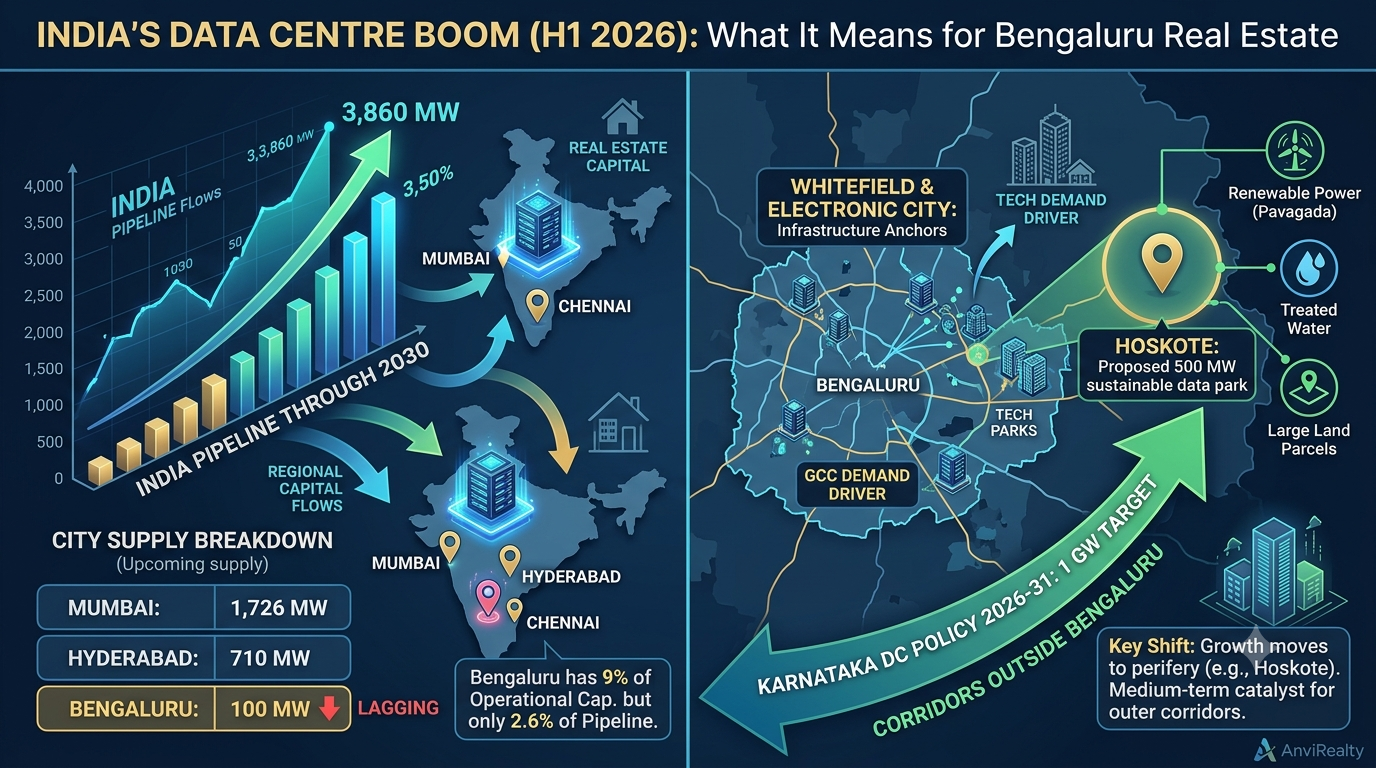
India is building data centres at a pace the country hasn't seen before, with a 3,860 MW pipeline through 2030. Bengaluru, despite being India's tech capital, has one of the smallest pipelines among the major markets. Here's what Cushman & Wakefield's H1 2026 update shows, why Bengaluru is lagging, which parts of the city are involved, and what it means for property buyers and investors.
The National Picture in Brief
According to Cushman & Wakefield's India Data Centre H1 2026 Update, released on 23 September 2026:
| Metric | H1 2026 |
|---|---|
| New capacity added in H1 2026 (top 7 markets) | 178 MW |
| Total operational capacity | 1,789 MW |
| Pipeline through 2030 | 3,860 MW |
| — of which under construction | 509 MW |
| — of which in planning | 3,351 MW |
| Number of data centres | 147 |
| Number of operators | 33 |
| Colocation vacancy | 14.9% |
| India's estimated development capital requirement through 2030 | US$29.9 billion |
The report frames India as one of Asia Pacific's largest data centre investment markets, and also one of its most underpenetrated — with roughly 825,333 people per MW of operational capacity, indicating significant room to grow. The drivers it cites are hyperscale cloud adoption, AI deployments and enterprise digital transformation.
The regional context is just as striking. Cushman & Wakefield projects Asia Pacific data centre capacity will grow 2.7 times by 2030, requiring more than US$280 billion in capital expenditure, with India expected to account for nearly US$29.9 billion of that.
City by City: Where Bengaluru Stands
| Market | Operational capacity (MW) | Upcoming supply (MW) |
|---|---|---|
| Mumbai | 890 | 1,726 |
| Chennai | 214 | 368 |
| Delhi NCR | 183 | 387 |
| Bengaluru | 162 | 100 |
| Hyderabad | 151 | 710 |
| Pune | 133 | 258 |
| Kolkata | 22 | 84 |
Source: Cushman & Wakefield, India Data Centre H1 2026 Update. City figures are as published; they may not sum exactly to the national totals.
Bengaluru is the fourth-largest operational market today, with 162 MW. But its pipeline tells a different story:
- Bengaluru's upcoming supply of 100 MW is the second-smallest of the seven markets, ahead only of Kolkata.
- Every other market's pipeline is larger than its current operational base. Hyderabad's pipeline is roughly 4.7 times its current capacity; Mumbai's, Pune's and Delhi NCR's are roughly double. Bengaluru's pipeline is only about 0.6 times its current capacity.
- Bengaluru holds about 9% of India's operational capacity but only around 2.6% of the national pipeline (based on the 1,789 MW and 3,860 MW totals).
(Rankings, ratios and shares above are AnviRealty calculations from the figures in the Cushman & Wakefield release.)
Cushman & Wakefield attributes Bengaluru's growth to ongoing infrastructure expansion initiatives, while pointing to Hyderabad's rise on the back of hyperscaler investment and AI-related demand, Chennai's subsea connectivity, and Pune's competitively priced, development-ready land.
The takeaway for Bengaluru is clear: the city that powers much of India's software industry is not where most of India's new data centre capacity is being built.
Why Bengaluru Is Lagging — and What the State Is Doing About It
The Cushman & Wakefield release doesn't spell out the reasons for Bengaluru's smaller pipeline, but the Karnataka government's own policy response points to the constraints it's trying to fix.
Data centres need three things at scale: large land parcels, abundant and reliable power, and water for cooling. Within Bengaluru's built-up limits, all three are scarce. Notably, recent state planning has focused on exactly these factors.
The 1,000 MW data park plan (announced May 2026)
The state announced plans for data park clusters with a combined capacity of 1,000 MW across Bengaluru, Mysuru and Mangaluru, using a hub-and-spoke model with Bengaluru as the primary hub. At its centre is a proposed 500 MW sustainable data park near Hoskote, on Bengaluru's eastern outskirts, designed to draw partly on renewable power from the Pavagada Solar Park and on around 60 million litres per day of secondary treated water. The state also identified about 350 acres in Mangaluru's Baikampady Industrial Area for a data park, and began land identification in Mysuru.
Karnataka Sustainable Data Centre Policy 2026–31 (approved September 2026)
The state cabinet subsequently approved a new five-year policy with these headline features:
- Target: 1 GW of cumulative data centre IT capacity by 2031, and a 10–12% share of India's AI-ready data centre capacity
- Budget framework: ₹1,300.45 crore over five years
- Location strategy: Sustainable Data Centre Zones and new data centre corridors outside Bengaluru, with sites identified using resource mapping of power and water availability
- Water: Reimbursement of 100% of charges for procuring and using treated water, capped at ₹8 lakh per year, for eligible units in Bengaluru and elsewhere
- Energy efficiency: Incentives linked to power usage effectiveness (PUE), for both new and expansion projects
- Scope: Data centre units and parks, edge data centres, cable landing stations, and AI- and quantum-ready infrastructure
- A Centre of Excellence for data centre research, training and capability development
The direction of travel is unmistakable: the state's own strategy is to grow data centre capacity around and beyond Bengaluru, not inside its core.
The Key Data Centre Areas in and Around Bengaluru
Based on operator disclosures and data centre directories, Bengaluru's existing capacity is concentrated in two established clusters, with a third, larger hub proposed on the city's edge.
1. Whitefield — Bengaluru's densest data centre cluster
Whitefield, particularly the EPIP Zone, the International Tech Park Bangalore (ITPB) campus, Pattandur Agrahara, and the Sadaramangala industrial area, hosts the largest concentration of the city's data centres.
Operators listed in the area include Nxtra (Airtel), STT GDC India, Iron Mountain Data Centers (formerly Web Werks), CapitaLand Data Centre (within ITPB), Global Cloud Xchange and Telstra, among others. Iron Mountain describes Whitefield as Karnataka's densest data centre cluster; its own Whitefield facility, BLR-1, has 4.1 MW of power capacity.
Why Whitefield: proximity to Bengaluru's largest concentration of IT companies and tech parks, along with established network connectivity.
2. Electronic City Phase 1 — the southern cluster
Electronic City Phase 1 is the city's second established cluster, with operators including NTT DATA, Sify, CtrlS and ESDS. NTT's Bengaluru 2 facility in Electronic City offers 4.5 MW of critical IT load.
Why Electronic City: a long-established IT and electronics hub, now also served by the Namma Metro Yellow Line.
3. Hoskote — the proposed hyperscale hub
The state-proposed 500 MW sustainable data park near Hoskote would, if delivered, be larger than Bengaluru's entire current operational capacity of 162 MW. The Karnataka government has identified Hoskote as a potential hub for new data centres, and it anchors the Bengaluru portion of the state's 1,000 MW data park plan.
Why Hoskote: greater land availability on the city's periphery, and the potential to pair renewable power with treated water — the two constraints the state's new policy is built around.
An important caveat: this is a proposal. As of September 2026, no completion timeline or private operator commitment for the park was disclosed in the sources reviewed for this article.
What This Means for Bengaluru Real Estate
1. Data centres don't create the same housing demand as offices
It's worth being clear about this. A data centre occupies large amounts of land and power, but it typically employs far fewer people per square foot than an office campus. A new data centre doesn't bring thousands of commuters the way a new tech park does. So the direct effect on residential demand in the immediate area is usually modest.
The larger residential effects tend to come indirectly — through the infrastructure that data centres require (power substations, transmission upgrades, fibre networks, treated-water pipelines), and through the cloud, AI and global capability centre activity that data centre capacity supports.
2. Whitefield and Electronic City: infrastructure that underpins the tech economy
For residential buyers in Whitefield and Electronic City, the existing data centre clusters are one more layer of the established technology ecosystem that already drives housing demand in both areas. They reinforce the depth of digital and power infrastructure in these corridors, rather than introducing a new demand driver.
3. Hoskote: a potential new anchor for East Bengaluru's outer corridor
Hoskote is where the data centre story could matter most for real estate. Several large residential projects are already being launched along the Hoskote–Old Madras Road corridor. A state-backed hyperscale data park nearby would add a significant industrial and technology anchor to an area that currently relies heavily on future infrastructure — such as the Satellite Town Ring Road and proposed metro extensions — for its long-term growth story.
The likely effects, if the park is delivered:
- Infrastructure upgrades — power transmission, roads and treated-water networks built for the park could benefit the wider area
- Land values for large, power-accessible industrial parcels in the vicinity are likely to be most directly affected
- An additional anchor for the corridor's longer-term commercial and residential development
For homebuyers, though, treat this as a medium- to long-term catalyst, not a reason to pay a premium today. The park is proposed, not under construction, and timelines for this kind of infrastructure tend to stretch.
4. Bengaluru's smaller pipeline isn't necessarily bad news for residents
From a resident's perspective, the state's push to locate new capacity outside the city's core has a practical upside. Data centres are resource-intensive, and the new policy's emphasis on renewable energy, treated water and efficiency is a response to the very constraints — water stress and power demand — that Bengaluru residents already feel. Steering hyperscale capacity toward planned zones with dedicated resources is likely to be better for the city's liveability than allowing it to compete for the same water and power within existing urban areas.
5. The bigger picture: AI and GCC demand is the real driver
The national data centre build-out is a response to rising cloud and AI usage — the same forces driving global capability centre expansion, which is a major source of Bengaluru's office demand and, in turn, its housing demand. Bengaluru may not be the largest data centre market, but it remains a primary beneficiary of the technology activity that data centres support.
What Buyers and Investors Should Watch
- Formal notification and land allotment for the proposed Hoskote data park — the first concrete signal that the plan is moving beyond announcement
- Operator commitments — named private players signing on to build in the park
- Power and water infrastructure — new substations, transmission lines and treated-water pipelines in the Hoskote corridor, which would benefit the wider area
- Implementation of the 2026–31 policy — particularly where the Sustainable Data Centre Zones are formally designated
- Cushman & Wakefield's next update — whether Bengaluru's 100 MW pipeline grows as new projects are announced
The Bottom Line
India's data centre market is scaling fast: 1,789 MW operational, a 3,860 MW pipeline through 2030, and nearly US$29.9 billion in development capital expected. Bengaluru, India's technology capital, holds a respectable 162 MW of operational capacity but only a 100 MW pipeline — the second-smallest of the seven major markets, as growth shifts to Mumbai, Hyderabad and others.
The Karnataka government's response is to build capacity around and beyond the city, with a proposed 500 MW data park near Hoskote at the centre of its Bengaluru plans. For real estate, the established Whitefield and Electronic City clusters reinforce corridors that are already strong. The bigger potential shift is on the eastern periphery: if the Hoskote park is delivered, it could add a meaningful new anchor to one of East Bengaluru's fastest-developing residential corridors. Until then, it's a catalyst to monitor, not one to price in.
References
- Cushman & Wakefield, "India's Data Centre Development Pipeline through 2030 Reaches 3,860 MW as Capacity Expansion Accelerates Across Major Markets," press release, 23 September 2026. https://www.cushmanwakefield.com/en/india/news/2026/09/india-data-centre-h1-2026-update
- Cushman & Wakefield, India Data Centre Market H1 2026. https://www.cushmanwakefield.com/en/india/insights/india-data-centre-update
- MediaNama, "Karnataka sustainable data centre policy 2026–31 explained," September 2026. https://www.medianama.com/2026/09/223-karnataka-sustainable-data-centre-policy/
- The News Minute, "Karnataka's new data centre policy puts water, energy in focus: What does it say?" September 2026. https://www.thenewsminute.com/amp/story/karnataka/karnatakas-new-data-centre-policy-puts-water-energy-in-focus-what-does-it-say
- Deccan Herald, "Karnataka eyes Rs 60k crore investment under new data centre policy," July 2026. https://www.deccanherald.com/business/karnataka-eyes-rs-60k-crore-investment-under-new-data-centre-policy-4077831
- TMV, "Karnataka Unveils 1,000 MW Data Park Plan, Eyes Massive Private Investment," 2 May 2026. https://tmv.in/article/karnataka-unveils-1000-mw-data-park-plan-eyes-massive-private-investment
- Iron Mountain Data Centers, Bangalore data center (BLR-1). https://www.ironmountain.com/en-in/data-centers/locations/apac/bengaluru-data-center
- NTT DATA, Bengaluru 2 Data Center. https://services.global.ntt/en-us/services-and-products/global-data-centers/global-locations/india/bengaluru-2-data-center
- Inflect, Data Centers in Bengaluru, India (operator and location directory). https://inflect.com/datacenters/apac/india/bengaluru
National and city-level data centre figures are from Cushman & Wakefield (references 1–2). Bengaluru's shares of national capacity and pipeline, pipeline-to-capacity ratios and city rankings are AnviRealty calculations based on those published figures. Karnataka policy details are from references 3–6; operator and location details from references 7–9. Analysis of real estate implications is AnviRealty's own and should not be attributed to Cushman & Wakefield or the Government of Karnataka.
This article is for informational purposes only and does not constitute investment advice.
Published by AnviRealty — Bengaluru's data-driven real estate advisory platform.